


Diagnostics as a Service turns lab testing into infrastructure
Diagnostics as a Service is a model in which one provider runs the whole testing chain, from the kit and the sample collection through the laboratory analysis to the result your customer reads. You buy all of it on one contract with one integration, instead of assembling five suppliers yourself.
Aniva runs that chain for clinics, brands and platforms across Europe. Your customers see your name on the kit, on the dashboard and on the report, while an accredited partner laboratory performs the analysis and a courier moves every sample.
Orderable parameters
Contract to first sample
Core panel turnaround
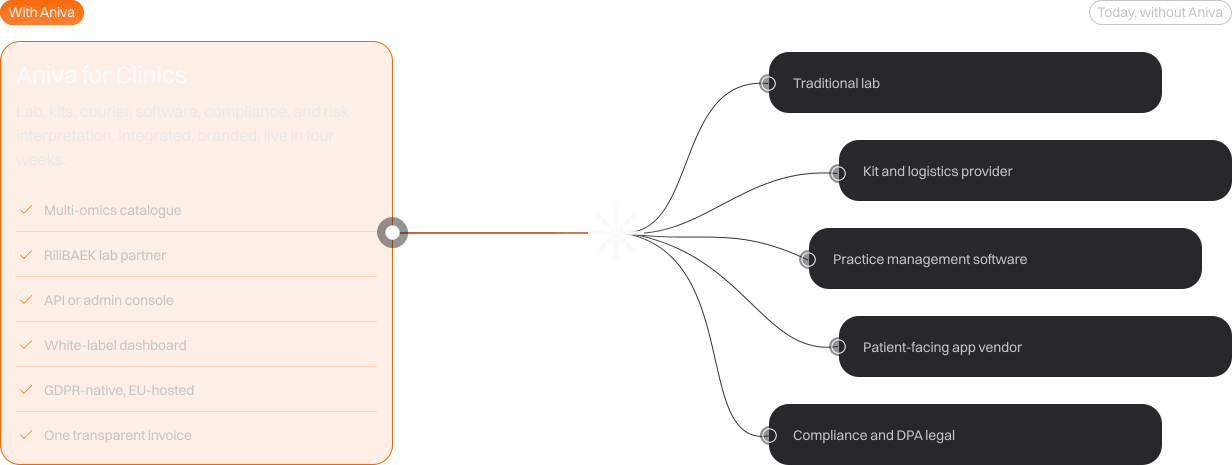
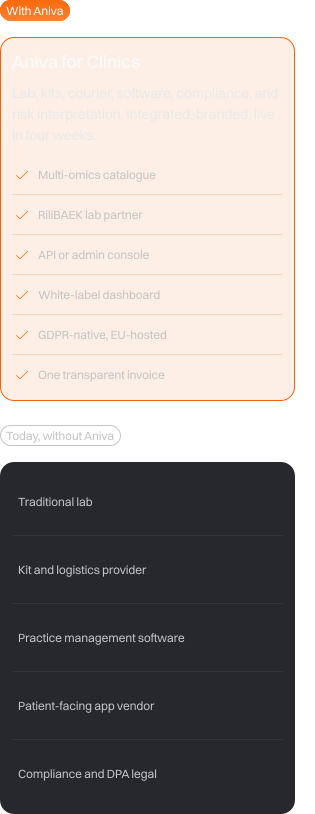
One partner replaces the five suppliers you would otherwise assemble yourself.
Kits, collection, laboratory, logistics and the results layer. One contract instead of five separate vendors, five separate invoices, and your own team acting as the integrator.
Four steps run between an order and a result
The provider is responsible for all four of them.
Your team orders the test
An order starts in the partner console or through the REST API, so your developers can trigger it from inside your own product.
The sample is collected
Your customer collects a sample at home with a capillary or at-home kit, or gives a venous sample in your clinic or at one of 25+ partner locations across Germany.
The laboratory analyses the sample
Analysis is performed by an accredited partner laboratory, which holds ISO 15189 accreditation and works under RiliBAEK, the German guideline for laboratory quality assurance.
The result is returned twice
Structured results are available through the API with signed webhooks, and your customer reads the same values in a white-label dashboard with a downloadable PDF.
Modalities, from clinical chemistry to proteomics and whole-genome sequencing
Collection methods, from a venous draw to a kit your customer uses at home
Partner draw locations across Germany, alongside a draw by your own team
Ordering, status, results and webhooks through one integration
Your customers test at home or in a room, and you sell both.

Venous draw
In your clinic or at 25+ partner locations

Capillary kit
Tasso, lancet, finger-prick

At-home kit
Mailed to your customer, prepaid return

Saliva
Hormones, genetics, microbiome

Urine
Metabolites, hormones, screening

Stool
Microbiome, iFOBT, calprotectin
A mailed kit covers a large part of what a preventive programme sells, because micronutrient status, hormone profiles and microbiome analysis all work from a sample the customer collects alone. Aniva ships capillary kits and at-home kits with prepaid return postage, so a customer anywhere in the country can test in the week they buy.
The venous draw is the part a mailed kit cannot do, because some assays need more serum than a capillary device collects and because some customers will not prick their own finger at all. Buying both routes on one contract means your programme never turns a customer away for choosing the format you did not buy.
Diagnostics as a Service, your own laboratory, or direct laboratory contracts
Three ways exist to put laboratory values inside a product, and the honest difference between them is what you have to build and who is responsible when something goes wrong.
A laboratory that already runs high volume in house is cheaper per test than any outsourced model, so the case for buying the chain is weakest where you have already built it. A point-of-care test that a nurse reads in the room does not need a logistics chain at all.
What a Diagnostics as a Service stack is made of
Six parts make up the service, and a provider that is missing one of them leaves that part with you.
White-label kits carry your brand
The kit, the instructions and the return packaging carry your name, and your customer does not read the name of a laboratory anywhere in the box.
Home collection covers most of a preventive panel
Capillary devices, at-home kits, saliva, urine and stool samples cover micronutrient status, hormone profiles and microbiome analysis without a clinic visit.
An accredited laboratory performs the analysis
The analysis is performed by a partner laboratory under ISO 15189 accreditation and RiliBAEK, and the same laboratory reports the values into your account.
One API covers ordering, status and results
The REST API uses an API key header and signed webhooks for every status change, and a sandbox with test data is open to your developers before you go live.
Logistics move every sample to the laboratory
Same-day courier pickup on draw days and prepaid return postage on home kits are part of the service rather than a separate supplier you find yourself.
Your team and your customer each get a screen
Your team works in the partner console and your customer reads the white-label dashboard, while the laboratory, the courier, the kits and the paperwork are behind both of them.
Who buys Diagnostics as a Service
Longevity and preventive clinics
A clinic offers a laboratory menu without running a laboratory, and the report carries the clinic's name rather than a supplier's.
Telehealth providers
A video consultation becomes a decision once a real laboratory value is on the screen beside it.
Health and fitness apps
An app adds biomarker features to a subscription without turning itself into a diagnostics company.
Insurers and employers
A prevention programme is built on measured values rather than on the answers to a questionnaire.
Medical practices and MVZ
A practice sells Selbstzahlerleistungen, which are services a customer pays for privately, with home collection between appointments.
Supplement and nutrition brands
A brand recommends a product from a measured value instead of from a survey answer, and it can measure again later.
The standards a provider works to
The compliance set-up that is usually a four-month side project, included by default.

RiliBAEK

ISO 15189

GDPR

EU-hosted

MDR-aware
Eight questions to ask a provider before you sign
Ask which parameters the accreditation covers
An ISO 15189 certificate covers a defined scope, so ask whether the parameters on your own panel list are inside it.
Ask how deep the catalogue is against your two-year roadmap
A brand selling one micronutrient panel needs perhaps thirty parameters, while a clinic that wants sequencing in year two is buying a catalogue it cannot yet name.
Ask which collection methods are live today
Home kits and venous draws are two different products, so ask which ones exist now and which ones are described as coming.
Ask what your developers get on day one
Ask for the documentation, a sandbox with test data, the webhook event list and the retry behaviour, and read them before the commercial call.
Ask how deep the white-labelling goes
White-label means something different at every provider, so ask which of the kit, the packaging, the dashboard, the PDF and the sub-domain you can put your own name on.
Ask where the data is processed and by whom
Ask for the processing agreement, the hosting location and the list of sub-processors, and check that the answer matches the market you sell in.
Ask which countries are covered today
Kit shipping, laboratory analysis and physical collection can each stop at a different border, so ask about all three per country.
Ask for a live reference in your own segment
A provider that already runs a partner like you can name them, and a reference call answers more than a capability list does.
Diagnostics as a Service questions we are asked first
What is Diagnostics as a Service?
Diagnostics as a Service is a model in which one provider runs the kit, the collection, the laboratory, the logistics, the results layer and the paperwork, so you buy testing on one contract instead of assembling five suppliers.
What does it cost?
Pricing scales with your volume and your panel mix, and a per-parameter and per-kit quote is part of the first call rather than a published list price.
How long does an integration take?
Aniva publishes four weeks from a signed contract to the first customer sample, which includes the white-label setup, the panel selection and the paperwork.
Which sample types are supported?
Six collection methods are live, which are the venous draw, the capillary kit, the at-home kit, saliva, urine and stool, and the parameter decides which of them a panel can use.
Do we need our own developers?
Your team can work entirely in the partner console without writing code, and the REST API is there for the partners who want testing inside their own product.
Who carries the regulatory responsibility?
The laboratory is responsible for the analysis under its own accreditation, Aniva is responsible for the platform, and the split is written into the partner contract before you sign it.
Which countries does Aniva cover?
Diagnostics as a Service is sold to partners across Europe, while the 25+ physical draw locations are in Germany, so ask about collection in each market you sell into.
How is Diagnostics as a Service different from a laboratory information system?
A laboratory information system is the software a laboratory runs inside its own walls, while Diagnostics as a Service is the whole chain from the order to the customer's report.
Book a 30-minute demo
A demo covers your panel list, the collection methods your programme needs and the integration your developers will build.